
Context
Running a villa that hosts stays, weddings and short-term rentals meant daily work living on personal reminders: things were remembered only when they went wrong, and nothing left a trace.
A complete property-operations platform for hospitality and short-term stays
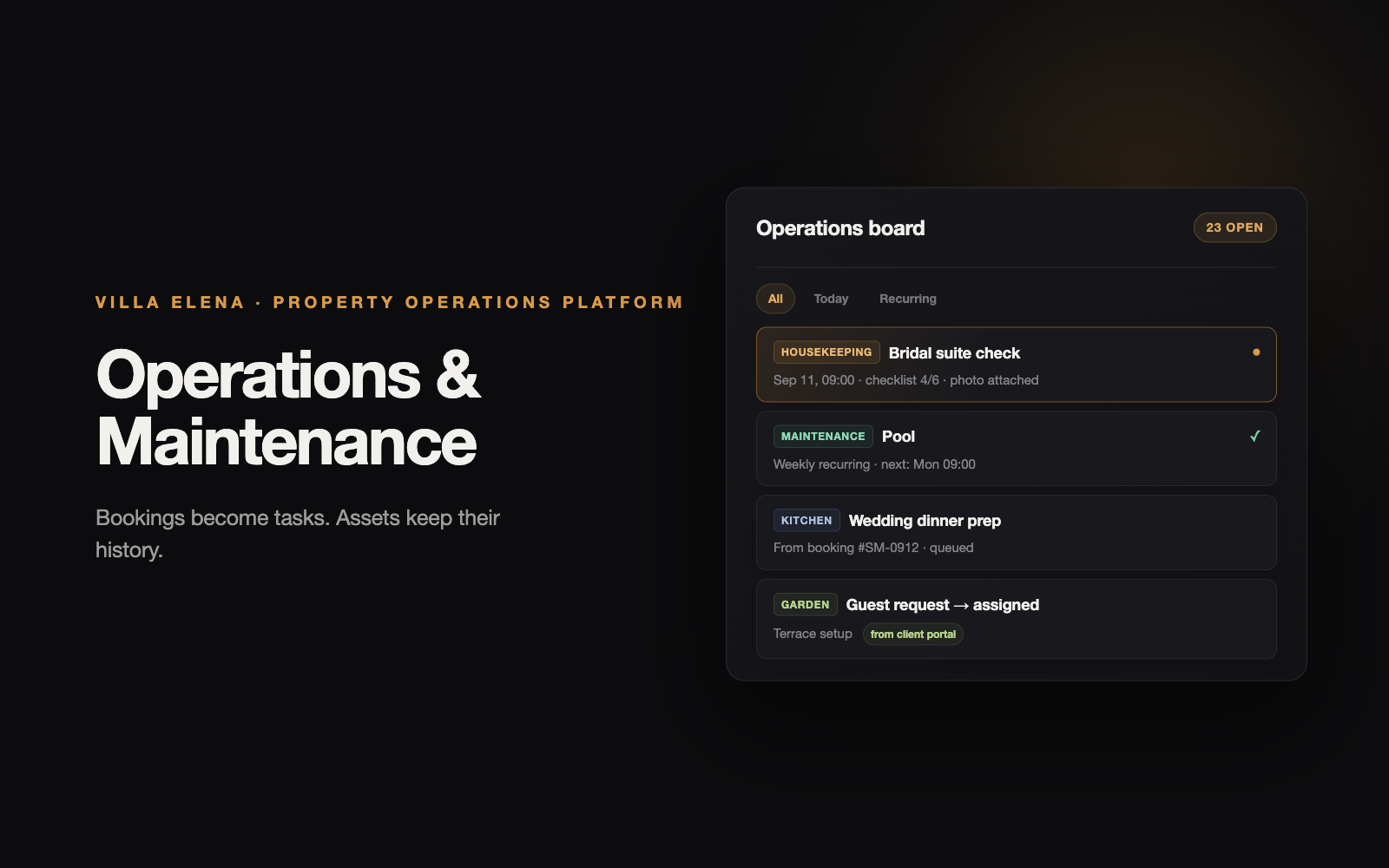
Running a villa that hosts stays, weddings and short-term rentals meant daily work living on personal reminders: things were remembered only when they went wrong, and nothing left a trace.
Let every arrival, departure or deadline generate by itself the tasks it requires — for the right team, at the right moment, with a trace left behind.
In production since July 2026; the villa is now populating its asset archive.
Operations & Maintenance joins two worlds. In the administrative area you prepare — once — roles, assets, templates and rules; in the operational area the staff finds what needs doing and records the result.
The flow is three steps: an event arrives (a booking is confirmed), a rule recognises what it requires, and the staff receives the work. You configure once what the villa demands; the engine checks events and calendar every hour, without ever creating duplicates; the staff executes, ticks the checklist, adds photos and closes the job.
Roles and teams. Roles say who each job belongs to — housekeeping, kitchen, garden, maintenance, front desk, management. Every template has a usual role, and a single rule can change it when needed.
Assets and places. An asset is anything whose work, maintenance and costs deserve a history over time: a system, a piece of equipment, a place. Linking operations to an asset builds an ordered record — the pool, the oven, the installations.
Suppliers. External contacts kept distinct from the internal team: name, contact and type are enough to find them the moment an operation calls for outside help.
Templates with checklists. A template is a reusable base: title, priority, team and a step-by-step checklist. Placeholders pick up names and dates from the booking automatically, and a checklist item can appear only for weddings, or only when a given service was purchased.
Rules. A rule links a moment to a template: an event, a purchased service, or the calendar. For bookings it can anchor to confirmation, check-in or check-out, shifting the deadline by a few days. The system creates exactly one operation per rule and booking.
An optional bridge to the staff’s phones. The system remains the home of every operation; the task-board bridge carries it to the staff’s phones and reports its state back. Switched off, everything keeps working inside the system.
From opening to closing, the checklist tells what really happened: each step ticked with its own weight, photos of the finished work attached from the phone, a closing note — and the operation is archived with its real story.
Recurring rules — “pool check, every week” — bring a new occurrence each period, never twice on the same date. Every intervention lands in the asset’s record together with its actual costs, so each part of the villa carries its own maintenance history.
A request sent by the client from their private portal becomes an open operation for the right team — once, and with full traceability.
Recognise the teams; register assets and places; enter the suppliers; prepare the templates; switch on the rules; and, if wanted, connect the bridge that brings the tasks to the staff’s phones.
Interactive demo
Set the rules once, then watch the engine: a booking arrives, the right jobs appear, and staff close them from their phone. Sample data only: nothing you do is saved.
Start the guided demo →Three ready-to-go packages cover the most requested builds — and when your project doesn't fit a box, we shape a proposal around its real scope.
See packages & pricing Or tell us about your project